Should Your Kid Code With AI? How to Make It a Teammate
6 min read
Your kid comes home and announces that the computer wrote their code for them. Your stomach drops a little. Wasn't the whole point that they'd learn to do it themselves?
That reaction makes sense. Most of us grew up with a simple rule: if a machine does your homework, you didn't learn anything. Calculators got banned from math tests. Copying from the internet got you a zero. So when you hear that kids can now type a sentence and get working code back, it's fair to wonder what's left for them to learn.
Here's what we've seen, both at our own kitchen table and in our classrooms. An AI coding helper (a tool that suggests or writes code when you describe what you want) can be a shortcut that skips the learning. Or it can be the best study partner your kid has ever had.
The difference isn't the tool. It's how kids are taught to use it.

What working programmers really do with AI
If you want a peek at where your kid's future is headed, look at the people already doing the job. In the 2024 Stack Overflow Developer Survey, one of the largest yearly surveys of programmers in the world, 76% of respondents said they were using or planning to use AI tools in their work. Most of them, 62%, were already using them.
And it helps. When GitHub ran a controlled experiment with its AI helper, Copilot, developers who used it finished a coding task 55% faster than those who didn't.
One of us spent a long career in software and security, including years at Microsoft. The engineers we respect most didn't stop thinking when AI showed up. They started asking better questions.
So let's name the worry directly, because it's a real one. If AI can write code, will there still be jobs for people who code? Nobody can promise you what the job market will look like when your fourth grader graduates college. But here's something that's true today: AI tools make mistakes. A lot of mistakes. They write code that looks right and isn't. They miss security holes. They ignore code styles and code guidelines. Sometimes they confidently make things up.
Someone has to catch that. And that someone has to understand code. A deep understanding, to be honest.
Kids who learn to direct AI, question it, and check its work are practicing the exact skill professionals lean on every day. That's not a consolation prize. That's the job.
A teammate, not a ghostwriter
Our favorite example comes from Harvard. Its famous intro course, CS50, built an AI helper students call the CS50 Duck. The name comes from "rubber duck debugging," an old programmer trick where you explain your problem out loud to a rubber duck until you spot the mistake yourself. The Duck is designed to guide students toward answers instead of just handing them over.
Professor David Malan, who teaches the course, put the goal this way in The Harvard Crimson:
"Our own hope is that, through AI, we can eventually approximate a 1:1 teacher:student ratio for every student in CS50."
That's the idea we love. Not a machine that does the work, but a patient helper that's there at 8:30 on a Tuesday night when your kid is stuck and you have no idea what a syntax error is. (It's a typo in the code's grammar, by the way. Think missing period, except the computer refuses to read any further until you fix it.)
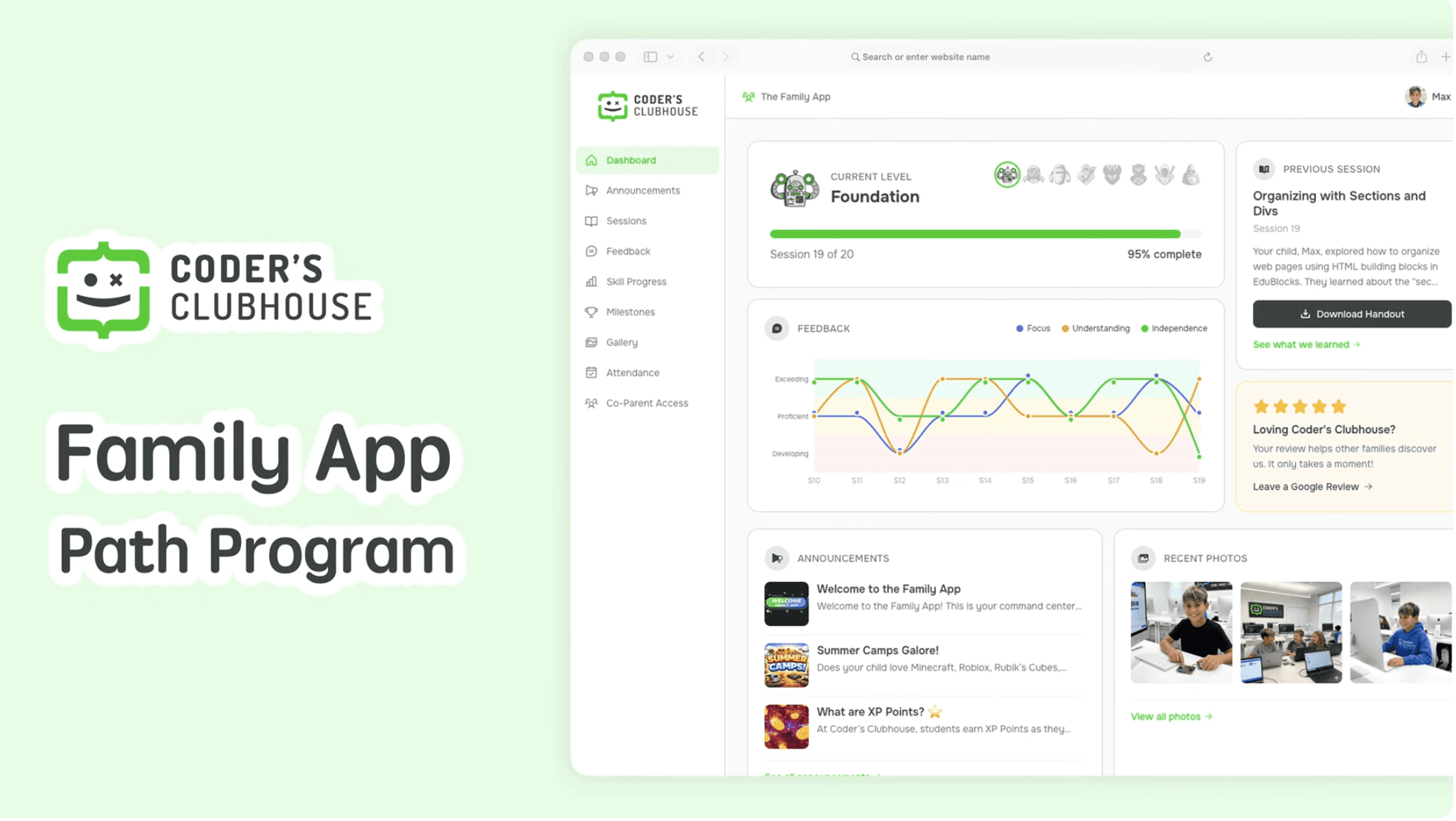
Here's how it looks for us at Coder's Clubhouse. In our Path Program, kids start with Scratch, a drag-and-drop block language, and work up to real text-based languages like Python and JavaScript. When they use AI, we teach them to treat it like a smart older teammate. They ask it to explain an error message instead of silently fixing it. They predict what their code will do before they run it. And when AI suggests something, they need to be able to tell an instructor why it works, because every session ends with a final project that a real person reviews.
A kid who asks "why is my loop running forever?" and gets a clear explanation learns something. A kid who types "write my game" and pastes the result learns very little.
Same tool. Totally different outcome.

A simple test for good screen time
You already know screen time isn't all the same. Your gut tells you a kid building a game is doing something different from a kid watching their fortieth short video in a row. You're right, and you don't need a computer science degree to tell the difference.
Next time your kid is on a screen, peek over their shoulder and ask yourself:
Are they making something, or mostly watching?
Could they explain what they just did if you asked?
Did something break, and did they try to fix it?
When they used AI, did they question the answer or just paste it in?
If the answers lean toward making, explaining, fixing, and questioning, that's creative screen time. It builds patience and that stubborn "I'm going to figure this out" attitude that shows up later in math class, science fair, and life.
Here's the part that surprises a lot of parents. Used well, AI can actually keep kids in builder mode longer. A kid who got stuck used to give up and drift back to scrolling. Now they have a helper that can nudge them past the wall so they keep going.
And in a Minnesota January, when it's dark before five and nobody wants to leave the house, the real question isn't whether your kid will be on a screen. It's what they'll be doing there.
What this means for your family
You don't have to know how to code to help your kid use AI well. You just have to stay curious. Tonight, try asking: "What did you build today? What went wrong? What did the AI get wrong?"
That last question is a favorite of ours. Kids love catching a computer in a mistake, and every time they do, they're proving they understand more than the tool does.
AI isn't going away, and honestly, we're glad. It's one of the most exciting things to happen to learning in our lifetime. Our job as parents is to make sure our kids are in the driver's seat, not the passenger seat.
If you'd like to see what that looks like in person, stop by Coder's Clubhouse on France Avenue in Edina for a free trial class. Your kid gets to build something real, and you get to watch their face when it finally works. No pressure, just a chance to see it for yourself.
Sources: Stack Overflow, "2024 Developer Survey: AI"; GitHub Blog, "Research: quantifying GitHub Copilot's impact on developer productivity and happiness"; The Harvard Crimson, "CS50 Will Integrate Artificial Intelligence Into Course Instruction"
Share This: